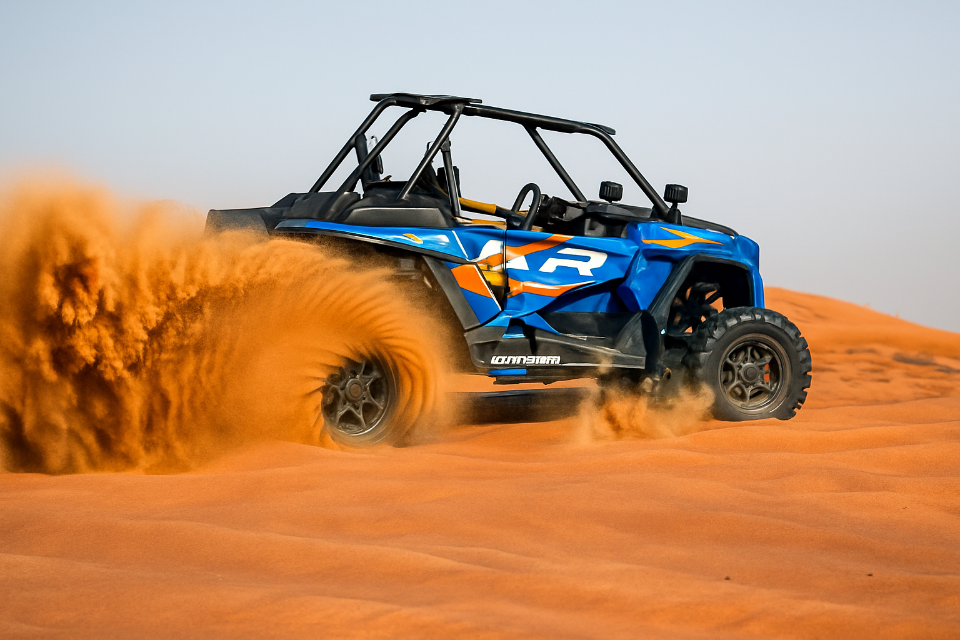
These two vehicle families dominate dune buggy fleets across the UAE, including ours, and guests often ask which is genuinely "better." The honest answer: it depends on your experience level and what you want from the ride.
Short answer: the Polaris RZR is smoother and more forgiving — the better choice for beginners and families. The Can-Am Maverick is faster and more powerful, better suited to confident drivers who want a more aggressive ride. Both run the same Al Badayer route and safety standard.
Polaris RZR: the all-rounder
The Polaris RZR is built for predictable, stable handling — power delivery is smoother and steering more forgiving, which is why most operators, including us, default first-time drivers to this vehicle. It's available in 2-seat and 4-seat configurations, making it a strong pick for couples and families alike.
Can-Am Maverick: the performance option
The Can-Am Maverick (particularly the turbocharged X3 and the larger Maverick R) delivers noticeably faster acceleration and a more aggressive dune feel. It rewards confident, experienced drivers who want more power under their right foot — see our Can-Am Maverick X3 Dubai tour for current pricing.
Side-by-side comparison
| Polaris RZR | Can-Am Maverick | |
|---|---|---|
| Handling | Smooth, stable, predictable | Aggressive, sharper response |
| Power | Moderate, well-balanced | Higher, turbocharged (X3) |
| Best for | Beginners, families, first-timers | Confident drivers, repeat riders |
| Seating | 2 or 4-seat | 2-seat (X3) or 4-seat (Maverick R) |
| From | AED 450 / 2 people | AED 850 / 2 people |
The engineering behind each vehicle family
Both Can-Am (built by BRP) and Polaris are the two dominant manufacturers in the global side-by-side (SxS) off-road market, and each brings a distinct engineering philosophy. Polaris generally tunes its RZR line for balanced, all-terrain versatility — suspension travel and power delivery are calibrated to feel predictable across varied conditions, from sand to rock to mixed terrain. Can-Am's Maverick line, particularly the turbocharged X3, is tuned more aggressively toward outright performance — sharper throttle response and a suspension setup built to reward faster, more committed driving. Neither approach is objectively superior; they simply target different driving experiences.
Suspension and ride comfort compared
Suspension travel — how far the wheels can move up and down to absorb terrain — is a genuine practical difference between the two. The Polaris RZR's suspension tuning prioritizes smoothing out bumps and dune transitions, which translates to a noticeably more comfortable ride for passengers, particularly over a longer 2–3 hour tour. The Can-Am Maverick's stiffer, more performance-oriented suspension transmits more of the terrain's texture to the cabin — part of the appeal for drivers who want to feel every dip and crest, but a real consideration if you get motion sensitive.
Fuel efficiency and range
For a guided tour of 1–3 hours, fuel range isn't something guests need to think about directly — vehicles are fuelled and inspected before every departure regardless of vehicle type. That said, it's worth knowing that the Can-Am Maverick X3's turbocharged engine burns more fuel per hour than the naturally aspirated Polaris RZR, a cost reflected in the higher tour price for Can-Am options rather than something guests manage themselves.
Noise and vibration differences
A less-discussed but genuinely noticeable difference: the Can-Am Maverick X3's turbocharged engine produces a distinctly different (louder, more aggressive) engine note than the Polaris RZR, part of the performance appeal for enthusiast drivers. If you're planning to record video or capture audio during your ride, this is worth knowing — the Can-Am's soundtrack reads as more dramatic on camera, while the Polaris RZR's quieter operation makes in-buggy conversation between driver and passenger easier throughout the ride.
Which vehicle photographs and films better?
Both vehicles photograph well against Al Badayer's red dune backdrop, but they create different visual stories. The Polaris RZR's smoother ride produces steadier action footage with less camera shake, useful if you're filming for social media from a mounted phone or GoPro. The Can-Am Maverick's more dynamic handling — visible dust kick-up, sharper cornering — tends to produce more dramatic still photography and video, at the cost of slightly rougher handheld footage.
Real guest feedback: what repeat riders say
Across 14+ years of guiding both vehicle types, a consistent pattern emerges in guest feedback: first-time Polaris RZR drivers describe the experience as "confidence-building" and "exactly challenging enough," while repeat Can-Am Maverick drivers describe it as "genuinely thrilling" and note the noticeably sharper acceleration compared to their first Polaris ride. Neither group tends to regret their choice — the two vehicles simply serve different expectations well.
Cost breakdown: is the price difference worth it?
The roughly AED 400 gap between a standard Polaris RZR tour and a Can-Am Maverick X3 tour reflects genuine differences in vehicle cost, fuel consumption, and maintenance — it isn't simply a premium pricing tier for the same experience. For a first tour, most guests find the Polaris RZR's price point delivers excellent value precisely because the smoother handling suits a first-time driver's needs. For a second or third visit, the Can-Am's added cost buys a genuinely different, faster experience rather than a marginal upgrade.
Terrain-specific performance at Al Badayer
At our own base in Al Badayer specifically, both vehicles handle the deep red sand well, but in slightly different ways worth knowing before you choose. The Polaris RZR's more balanced suspension copes gracefully with the softer, looser sand pockets found in the flatter warm-up sections of our route. The Can-Am Maverick X3's turbocharged power genuinely shines on the taller dune faces further into the reserve, where extra torque makes climbing steep sand noticeably more effortless. If your tour plan includes more advanced terrain later in the route, the Can-Am's power advantage becomes more apparent than it would on a beginner-focused, flatter itinerary.
Which should first-timers choose?
If this is your first dune buggy tour, start with the Polaris RZR — see our full beginner's guide for what to expect. Repeat guests and confident drivers looking for more speed and a sharper dune feel should look at the Can-Am Maverick range.
A brief history of each brand in off-road racing
Both manufacturers bring genuine motorsport pedigree to their tourism-fleet vehicles. Polaris has a long-standing presence in off-road and snowmobile racing, and the RZR line borrows suspension and chassis lessons from decades of competitive off-road development. Can-Am, under parent company BRP, has invested heavily in the Maverick X3's turbocharged platform specifically to compete in desert and rally racing, which is part of why the X3 in particular feels like a genuinely race-derived machine rather than a tourism-first design. Neither history matters for your actual guided tour experience, but it explains why enthusiast off-roaders often have strong brand preferences going into their first UAE desert tour.
Which vehicle do our own guides prefer?
Ask any experienced guide at Red Desert Motorcycles Rental and you'll get genuinely mixed answers — some prefer the Polaris RZR's predictability for long guiding days, others gravitate toward the Can-Am Maverick's sharper response when leading more experienced convoys. This split mirrors what we see in guest preference too, reinforcing that the "better" choice really does depend on what kind of ride you're after rather than one vehicle being objectively superior.
Group touring: mixed-vehicle convoys
A question we hear often from friend groups and families: can some of us drive Polaris and others drive Can-Am in the same convoy? Generally yes — mixed-vehicle convoys are common, and guides are experienced at pacing a group with both vehicle types together, matching overall convoy speed to whichever vehicle (and driver) needs the gentler pace. This makes it easy for a group with mixed experience levels and preferences to tour together rather than splitting into separate convoys.
Maintenance standards: what to expect regardless of vehicle
Whichever vehicle you choose, ask your operator about maintenance frequency — both Can-Am and Polaris vehicles require regular servicing to perform safely on dune terrain, and a reputable operator inspects every vehicle before each day's departures regardless of brand. See our Top 10 Safety Tips article for the full list of questions worth asking any operator about fleet maintenance.
A final word on resale, ownership context, and tourism relevance
While this comparison focuses on the guided tourism experience, it's worth noting both the Can-Am Maverick and Polaris RZR lines are also popular for private ownership among off-road enthusiasts in the region, which is part of why parts availability, servicing expertise and driver familiarity with both brands runs deep across UAE operators. This shared regional expertise benefits every guest, regardless of which vehicle you choose, since operators like ours maintain relationships with specialists for both platforms rather than favoring one brand due to limited servicing knowledge.
Expert tip: don't over-index on horsepower alone
A common mistake among first-time bookers is assuming more horsepower automatically means a better tour. In practice, the guided convoy format means both vehicles operate well within a comfortable safety margin — the Can-Am's extra power is felt in acceleration and dune-climbing capability, not in outright top speed during a guided tour, which is set by convoy pace regardless of vehicle. Choose based on the type of driving feel you want, not on horsepower numbers alone.
Can you try both?
Yes — many repeat guests book a Polaris RZR on their first visit, then upgrade to a Can-Am Maverick on a later trip once they're comfortable with the basics. Ask our team about switching vehicle type when you book your next tour.
Frequently asked questions
The Can-Am Maverick, particularly the turbocharged X3, delivers noticeably faster acceleration than the standard Polaris RZR.
It requires a bit more confidence due to its power and sharper response, which is why we generally recommend it for guests with some prior buggy experience.
Yes, with a guide's supervision, though most first-timers find the Polaris RZR more comfortable to start with — see our beginner's guide.
The Polaris RZR's suspension tuning generally produces a smoother, more comfortable ride over a longer 2–3 hour session.
Yes, if you want a genuinely faster, sharper driving experience — the cost reflects real differences in vehicle performance and fuel consumption, not just a pricing tier.
Conclusion
There's no universally "better" buggy between the Can-Am Maverick and Polaris RZR — only the better choice for your experience level and what you want from the ride. First-timers and families generally do best starting with the Polaris RZR; confident, repeat drivers looking for more power should look at the Can-Am Maverick range. For more on vehicle choice, see our Quad Bike vs Dune Buggy comparison or our beginner's guide. Ready to book? See our tour page or contact us with questions about which vehicle suits your group.